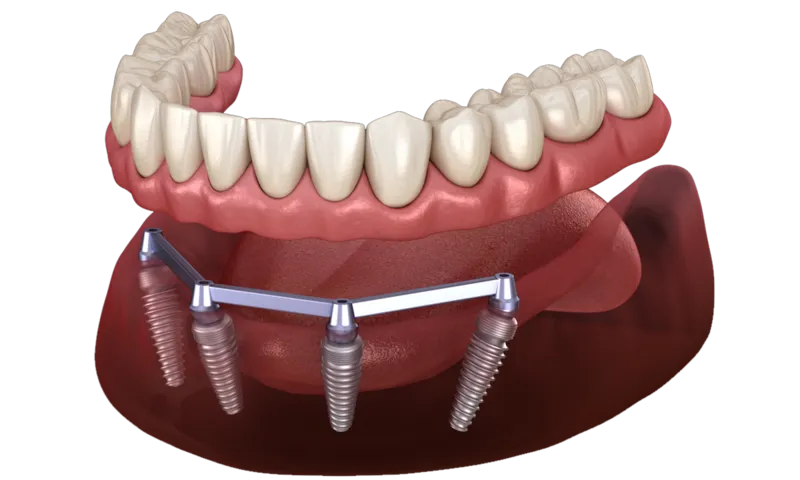
Most implant-supported dentures rest on 2 to 4 implants per arch if they snap in and out, and 4 to 6 implants per arch if they are fixed in place. The lower jaw usually needs fewer implants than the upper jaw, because lower jawbone is denser. The exact number is never a menu choice — it comes from a 3D scan of your bone volume, your bite forces, and whether you want a removable or permanent set of teeth.
This guide explains how surgeons actually decide the count, so the quotes and options you hear start making sense.
Why the number of implants matters
A traditional denture spreads chewing pressure across your gums, delivering roughly 20-30% of natural bite force — and because the jawbone underneath receives no root stimulation, it slowly shrinks, which is why dentures loosen over time. Implants change the mechanics entirely: titanium posts fuse with the jaw and carry the load like tooth roots, preserving bone and anchoring the prosthetic. The NIH's oral health resources cover the biology of tooth loss and bone in more depth.
More implants spread that load across more anchor points. But more is not automatically better — each post must sit in adequate bone, and a well-planned 4-implant arch outperforms a poorly placed 6-implant one.
The standard configurations
The decision path at a glance: 3D CBCT Scan → Bone Volume & Density Mapped → Removable vs Fixed Preference → Implant Count & Positions Planned
2 implants: the entry point for lower snap-ins
Two implants in the front of the lower jaw — where bone stays densest — can anchor a snap-in overdenture that clicks firmly into place. It is the most accessible upgrade from a loose lower denture, though the prosthetic still rests partly on the gums.
4 implants: the workhorse number
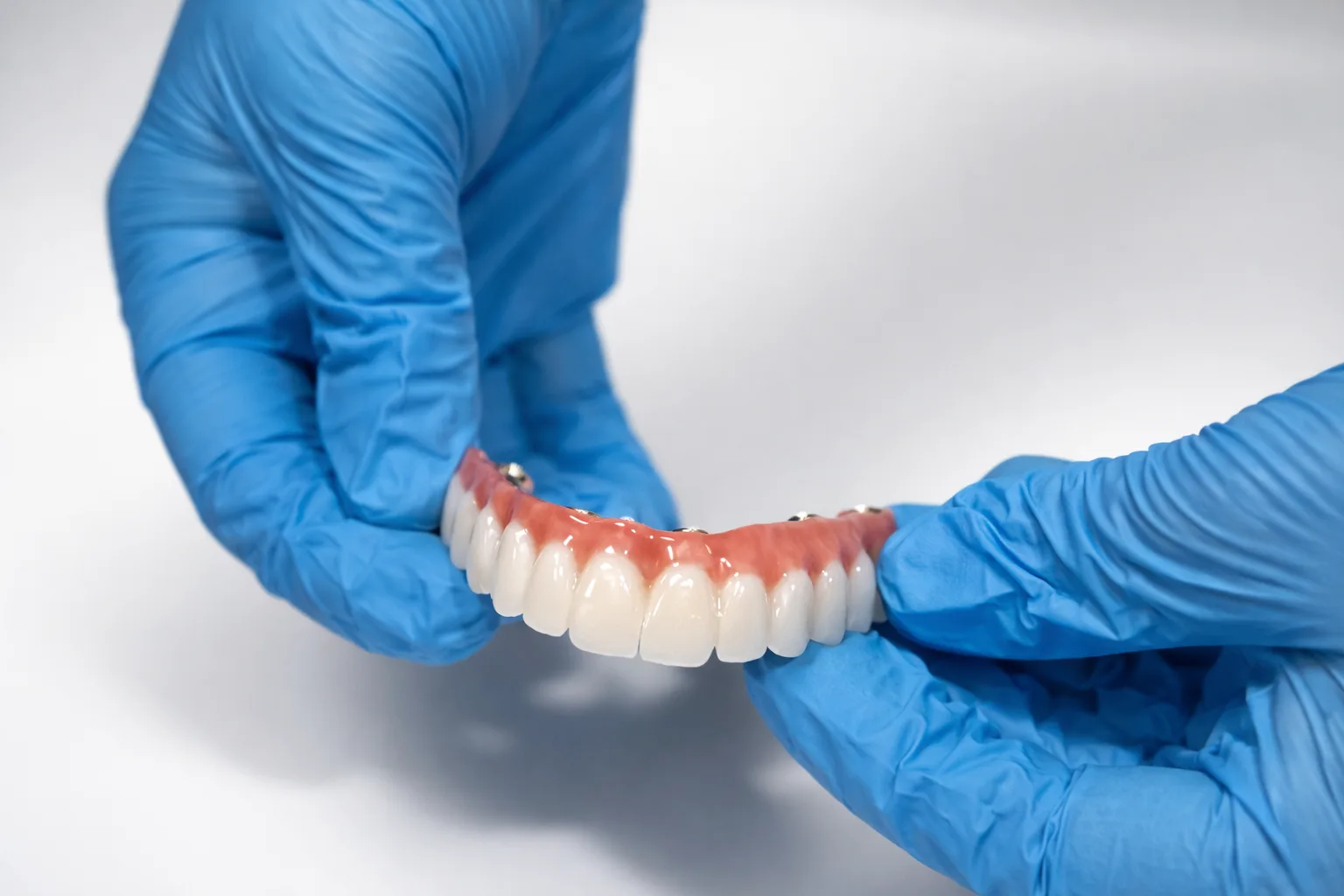
Four implants is the pivot point where both paths open up. As a snap-in, four posts allow a horseshoe-shaped upper denture with no palate-covering plastic, restoring taste and natural speech. As a fixed restoration, All-on-4 bolts a permanent bridge to four strategically angled implants — the tilted rear posts maximize contact with existing bone, which is why many patients qualify without grafting despite years of bone loss.
Upper jawbone is naturally less dense, and an upper prosthetic resists different forces than a lower one. Adding a fifth and sixth implant spreads chewing loads further and can improve long-term security in softer bone. Whether that trade-off is worth it in your case is exactly what the scan answers — our All-on-4 vs All-on-6 comparison goes deeper.
What actually determines your number
- Bone volume and density. The single biggest factor, measured precisely with 3D CBCT imaging — never guessed from a flat X-ray.
- Upper vs lower jaw. Lower arches succeed with fewer implants; upper arches typically need four or more.
- Removable vs fixed. If you want teeth that never come out, plan on at least four; the fixed vs snap-in trade-offs go beyond count alone.
- Bite force and habits. Heavy grinders and clenchers may benefit from additional posts.
- Budget. Fewer implants cost less up front — but the removable-vs-fixed choice moves the price more than one extra post does.
If bone is limited, tilted placement, positioning implants where bone is naturally strongest, or bone grafting can all rebuild the path to a stable arch. The FDA's dental implant overview is a good primer on how implant systems are evaluated for safety.
What each path costs
At Fusion Dental Implants, pricing is itemized and flat per arch, regardless of typical implant counts: snap-in systems from $9,999 per arch and fixed All-on-4 full-arch bridges from $17,999 per arch, with 0% financing options and a price match guarantee on comparable local quotes. Qualifying patients can receive implants and same-day provisional teeth in one visit, supported by our in-house lab.
Find your number
The honest answer to "how many implants do I need" is: let your bone decide, not a brochure. A free consultation with a 3D CT scan at our Roseville or El Dorado Hills office maps your bone in minutes, and our board-certified surgical team will show you exactly which configurations your anatomy supports — and what each one costs, line by line.
Schedule your free consultation
Why patients choose Fusion: In-House Dental Lab | Same-Day New Teeth | Transparent All-Inclusive Pricing | Lifetime Full-Arch Warranty | Price Match Guarantee
Frequently Asked Questions
How many implants do you need for an implant-supported denture?
Most snap-in (removable) implant dentures use 2 to 4 implants per arch, while fixed full-arch bridges typically use 4 to 6. The lower jaw can often be secured with fewer implants than the upper jaw because its bone is denser. Your exact number is determined by a 3D CBCT scan of your bone.
Can you support a denture on just 2 implants?
Yes — a 2-implant snap-in overdenture is a common and effective starting point for the lower jaw, where bone is dense. It dramatically reduces slipping compared to a suction-fit denture. The upper jaw usually needs at least 4 implants because its bone is softer and the prosthetic resists more lifting forces.
Why does the upper jaw need more implants than the lower jaw?
Upper jawbone is naturally less dense than lower jawbone, and the upper denture must resist gravity and different chewing forces. That is why upper snap-in dentures typically need 4 implants and upper fixed bridges often benefit from 6, while lower arches can succeed with fewer.
Is All-on-4 enough, or is All-on-6 better?
All-on-4 is a proven standard: the two rear implants are tilted to maximize existing bone, often avoiding grafting. All-on-6 spreads chewing forces across more posts and can add security in softer upper-jaw bone. Neither is universally better — the right count follows your bone volume and bite forces.
Does more implants mean a stronger bite?
Up to a point. Moving from a traditional denture (roughly 20-30% of natural chewing power) to a fixed implant bridge restores up to about 90%. The jump from removable to fixed matters far more than the difference between 4 and 6 implants, which is mostly about load distribution and long-term security.
What if I do not have enough bone for 4 or 6 implants?
Options include tilted-implant placement (the basis of All-on-4), positioning implants where your bone is naturally strongest for a snap-in system, or bone grafting to rebuild volume. A 3D CBCT scan shows exactly what your anatomy supports before anything is decided.
How much do implant-supported dentures cost per arch?
At Fusion Dental Implants, snap-in denture systems start at $9,999 per arch and fixed All-on-4 bridges at $17,999 per arch. Both are itemized, transparent prices backed by our price match guarantee, with 0% financing options available.
Can the implants be placed and teeth attached the same day?
In many cases, yes. With digital 3D planning, qualifying patients receive implants and a same-day provisional set of teeth in one visit, supported by our in-house lab. The final prosthetic is attached after the implants finish fusing with the bone over the following months.
This article is for general patient education and is not a substitute for personalized medical advice, diagnosis, or treatment. Every patient's oral health, anatomy, and healing response are different. Consult Dr. Antipov or your dental professional before making treatment decisions.
Sources: FDA: Dental Implants — What You Should Know · NIH/NIDCR: Oral Health Topics
About Fusion Dental Implants: We specialize in advanced dental implant solutions with locations in Roseville and El Dorado Hills, California.
Related reading: